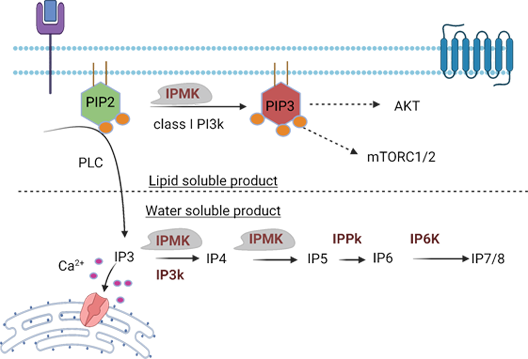
Inositol phosphates have been recognized as biologically relevant molecules since the identification in the early 20th century of inositol hexakisphosphate (IP6, also known as phytic acid) as an abundant constituent of plants that makes up their principal phosphate store. Interest in these substances escalated with the discovery in the mid-1980s of IP3 [inositol 1,4,5-trisphosphate] as a second messenger that releases calcium from intracellular stores. Mammalian cells produce higher-order inositol phosphates (IP4, IP5, IP6, etc.) whose roles in physiology is mostly obscure. Out of six major inositol phosphate generating enzymes (IP3kinase, IPMK, IP5kinase, IP6k1, IP6K2, and IP6K3), IPMK may be the most important, as deletion is embryonic lethal for mice. The inositol phosphate kinase function of IPMK is conserved from plants to mammals, where it converts IP3 to IP4 and IP4 to IP5. In mammals, IPMK also possesses phosphatidylinositol 3-kinase (PI3K) activity, generating phosphatidylinositol (3,4,5)-trisphosphate (PIP3), a second messenger that promotes cellular growth and cancer progression. We are interested in exploring the physiological importance of IPMK and inositol signaling in cell and animal models.
Gene expression analysis
Genetics & Epigenetics
The nucleus is the brain of any cell. Our lab’s major interest is to study how nuclear function influences disease progression, emphasizing cancer and neurodegenerative disorders.
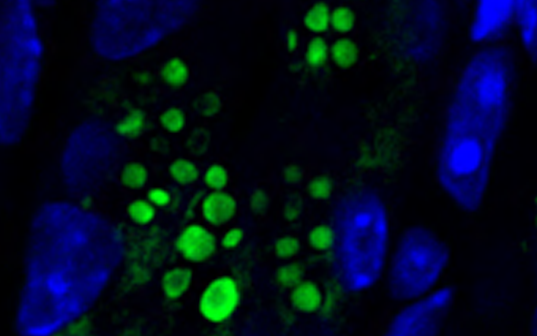
Intestinal Paneth cell granules in green
Intestinal Inflammation
According to GWAS study and mutation analysis IPMK is linked to intestinal carcinoid and crohn’s diseases. Our lab is currently investigating role of inositol signaling in intestinal function.
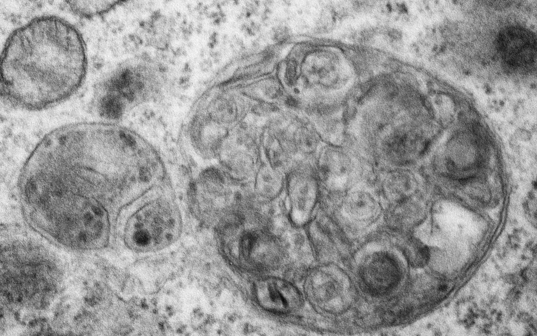
Trans mission electron microscopy of Autophagic vescicle
Autophagy
Autophagy is fundamental to maintaining cellular homeostasis and is linked to cancer and neurodegenerative disorders. However, the role of autophagy in controlling nuclear function is unknown. Our lab is currently investigating how autophagy impacts nuclear events.
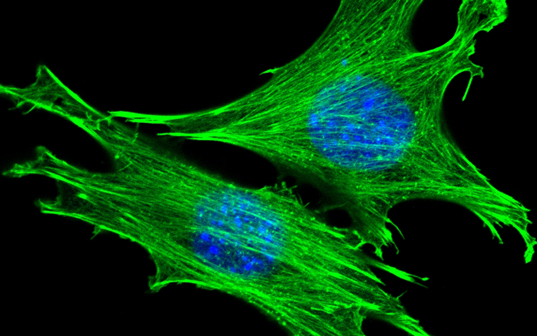
Actin cytoskeleton staining (Green)
Cell Migration
The primary threat for cancer is the phenomenon called metastasis. Cell migration and invasion are critical for metastasis. We are interested in studying the mechanism of cell migration.